
The Outbreak of WWII in Europe
Causation at a Glance…
| Economic | Political | Social |
| The Worldwide Economic Depression → US stock market crashed → effects persisted well into the late 1930s. “Have not” states became more aggressive and the “Haves” more cautious → Growth of authoritarian regimes (Gr and Italy) | Rise of Nazism in Gr and Fascism in Italy. Gr – wanted to reclaim land lost under TOV- Carve out living space (Lebensraum) for Germans in Eastern Europe-Destroy communism in Gr and other places where it could be found Italy (Mussolini), took over the countries banks and industries-long-held ambitions to build an Italian empire around the Eastern Mediterranean and North Africa, discussed a alliance with Gr (1939) | In Germany, people looked to authoritarian leadership as a political alternative. Political opposition was violently repressed in Germany. |
Failure of the League of Nations
Efforts at Disarmament in the 1920s
- Washington Naval Conference (1921)
- Locarno Treaties (1925)
- League Commission to prepare for World disarmament Conference (1926)
- Kellogg -Briand Pact (1928)
The World Disarmament Conference, 1932-34
- It was difficult to get all countries to agree on what offensive and defensive weapons were
- The resolutions passed did very little to ensure how the limitations on weapons would be achieved
- Individual countries used the Conference to raise their own particular issues.
- Dealing with Germany
- Most countries shared the view that the terms set out in the Treaty of Versailles should be fairer to Germany.
- Terms limiting the size of Gr’s military were perceived to be unfair
- Every country should disarm to Gr’s level
- 2nd option: Gr to rearm to a level closer to that of the other powers
- France had a painful experience with Gr in WWI and pressured the League against option 2.
- They either demanded that Fr continue to have a much larger armed forces than Gr, or have Br and US guarantee that they would fight alongside Fr if a war ever broke out between Fr and Gr.
- 1. Br and US did not want to guarantee Fr’s future security
- 2. Gr accused Fr and other major powers of hypocrisy
- 3. July 1932, Gr proposed that all countries to disarm to its level
→ Gr walked out of the Conference when they failed to agree on the principle of “equality” and the Conference broke.
The Disarmament Conference reconvenes…
- February 1933
- Leader of Gr was now Adolf Hitler
- Appeared to be interested in disarmament but as Historians know today, Hitler had secretly started a rearmament programme in Gr instead.
- Hitler continued calling for large-scale disarmament but he knew full well that the other countries would not disarm to the level that Gr faced under TOV → justification he needed to rearm Gr
- October 1933, pulled Gr out of the Disarmament Conference and from League of Nations
The Abyssinian Crisis, 1934-1936
- Italy wanted to build up its empire through conquest.
- What happened at the Wal-Wal Oasis?
- What did Haile Selassie do?
The League Loses Credibility
- The failure to impose sanctions on Italy decisively led to the Italian takeover of Abyssinia
- Hitler was convinced that the League would not be able to hinder Gr’s plan of expansion
- Gr troops marched into the Rhineland in March 1936
This was an act against the Treaty of Versailles but the League did nothing to stop it
- 1936 – Rome-Berlin Axis
- Collapse of collective security
Nazi Gr’s aggressive foreign policy
Hitler’s foreign policy aims:
- Abolish the treaty of Versailles
- Destroy communism
- Get Lebensraum for Germans who were believed to be the superior Aryan race, who should create an empire to rule over the inferior races
- Embrace militarism
Gr’s increasing aggression in 1933-1937
Activity #1: Fill up the cause effect table below on two of the given topics:
- Leaving the League of Nations (1933)
- Rearmament (1933-1935)
- Disarmament (1934)
- The Saar Plebiscite (1935)
- Remilitarisation of the Rhineland (1936)
- The Spanish Civil War (1936)
- The Anti-Comintern Pact (1936)
- The Axis Alliance (1937)
Policy of Appeasement in the 1930s → Britain and France giving in to Hitler’s demands

- US Isolationism
- Sympathy for Gr
- ___________________
- ____________________
Activity #2: Verbally explain one of the factors to Mrs Chen,
Source B: This cartoon of February 1938 by the British cartoonist David Low shows Germany crushing Austria. Next in line is Czechoslovakia. At the back, Britain says to France, who is next-to-last: ‘Why should we take a stand about someone pushing someone else when it’s all so far away?’ .
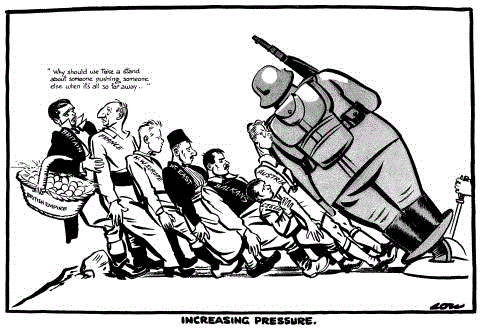
Study Source B. What is the message of the source?
 RVCooks
Leave a comment